Before Apple, there was Commodore: The beige computer that made tech mainstream
Plus: loud ads are being banned in California and the latest on the future OpenAI devices.

Hi everyone, today we’re going to talk about a beige computer that once controlled 40% of the U.S. market and outsold Apple, IBM, and Atari combined. We’re also going to break down some tech news, including the upcoming OpenAI devices. I think I want to start chatting with everyone in the Substack chat. Let me know if you’d be down!
- Rachel
Despite being ingrained in the tech world, I actually loathe getting new technology. I’ll be the first to hop on a new app or try new software, but there is something about hardware that feels sluggish and heavy to me. I like to use my phones until they stop turning on, which happens every few years, or until I run over them with a Citi Bike and they become unusable. That has only happened once, as far as my dad knows.
Right now I am writing this on a MacBook Air that was gifted to me after an internship six years ago. There are stains on the bottom of the screen from when a Hydro Flask leaked in my tote bag when I was 20. The screen has been permanently discolored ever since, and everything on the lower half now looks tie-dyed. The Hydro Flask is long gone, but my unwillingness to spend money or time on new tech has kept the laptop alive far longer than it deserves.
The aquatic MacBook Air can handle emails and Substacks, but not much else. A few months ago, my work laptop just stopped turning on minutes before a recording.
A client was kind enough to lend me a replacement, which felt a bit like borrowing someone’s car and hoping they never ask for it back, and I have been itching to return it out of fear it will also see a Citi Bike fate. I also need to stop emailing myself files between the Air and the work laptop because of the permission issues. It feels ridiculous, like passing USB drives in 2013.
Yesterday, I spent more money than I am comfortable admitting online on a new computer. It is still in the box and every time I look at it, my stomach turns. I ended up getting a 2024 MacBook Pro. Used. Still expensive.
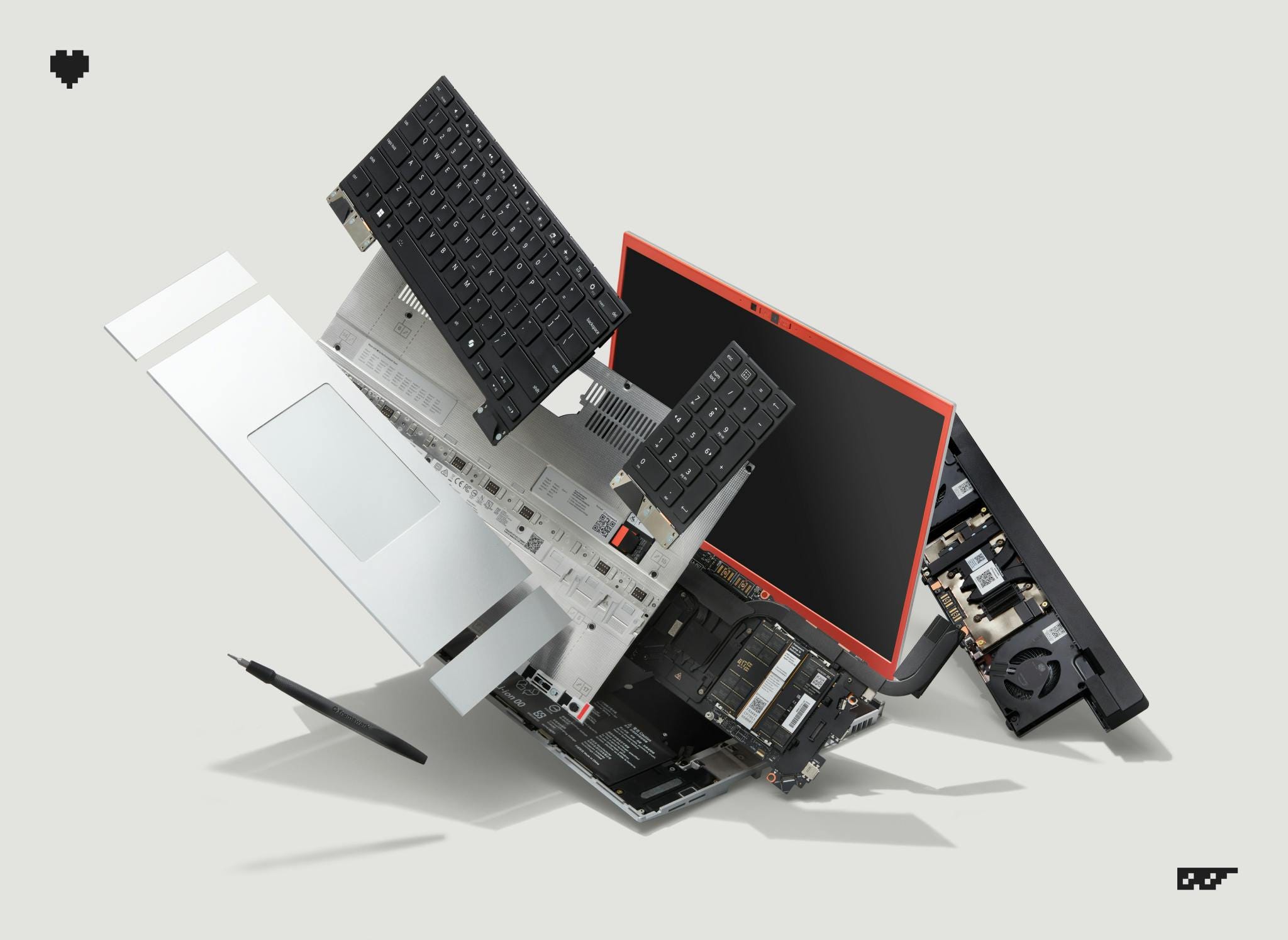
I hate how Apple has me in a chokehold. The new Framework 16 laptop came out recently, and if I were starting over, I might go that route. Framework makes repairable, upgradeable laptops designed to last. The idea of owning one thing and simply replacing the parts that wear out feels sensible. It reminds me of my wardrobe. If my favorite jeans rip, I do not buy a whole new outfit. I fix the jeans, or replace them. The shirt stays the same.
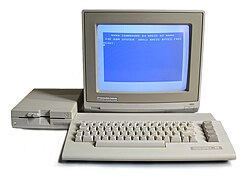
However, my favorite jeans never rip because they are extremely old and are from a time when jeans were made well and not meant for a landfill. If computers worked this way too, I would probably own a Commodore 128.
The beige computer that changed everything
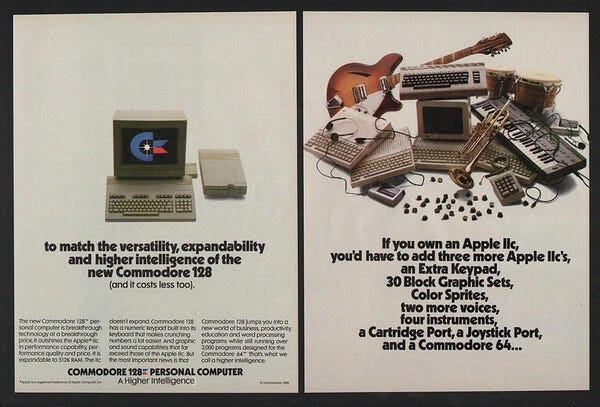
The Commodore 128 came on my radar recently after I was looking at old tech ads to post over on Substack as a note to pay homage to the fact that it’s New York Tech Week. One ad I always think about is the “Sorry, no beige” ad from Apple.
![Apple: Sorry, no beige [610 x 826] : r/AdPorn](https://substackcdn.com/image/fetch/$s_!xRmA!,f_auto,q_auto:good,fl_progressive:steep/https%3A%2F%2Fsubstack-post-media.s3.amazonaws.com%2Fpublic%2Fimages%2Ff6f8d57c-9c5e-4deb-8c39-2fc6fafce808_610x826.png "Apple: Sorry, no beige [610 x 826] : r/AdPorn")
This one, seemingly clapping back at Apple, caught my eye. It’s a beige computer basically dunking on Apple, saying you need far too many gizmos and gadgets to make an Apple computer useful and that the Commodore 128 not only costs less but is more versatile, expandable, and has higher intelligence than an “Apple IIc.” I had never really heard of Commodore, and this sent me down a rabbit hole.
Commodore was once the most popular computer brand in the world and helped make home computing possible for everyone. And now, the computer that helped make tech mainstream is coming back.
A YouTuber named Christian Simpson, who runs the channel Retro Recipes, is reviving the Commodore brand with the Commodore 64 Ultimate. It is a modern version of the original computer that still works with vintage cartridges but includes updated ports like USB and HDMI. What makes it particularly interesting is that it bridges two worlds: nostalgic collectors get authentic retro computing with original peripherals, while modern users can connect it to contemporary displays and storage without hunting down obsolete hardware.
The new model is available for preorder and is expected to ship in November 2025. Early previews show it keeps the same keyboard shape and color scheme that made the C64 instantly recognizable.
I’ve been thinking about how older, more nostalgic hardware like the Porta Pro headphones in Rhythm Beige is becoming more popular, at least for Gen Z internet girls and coffee shops in Brooklyn. Personally, I like the beige and think Commodore rocked it.

Before Apple, there was Commodore
Before Apple became the face of modern computing, Commodore owned the living room, powering a generation of programmers, gamers, and musicians. It quietly became the best-selling computer in history.
In the early 1980s, the Commodore 64 made computing accessible. It was cheap, reliable, and fun. Launched in 1982 for $595 (about $1,940 today), the C64 packed 64 KB of RAM (for context, today’s baseline MacBook Air has 8 GB, or 125K times more). It featured a VIC-II graphics chip with 16 colors and a SID sound chip known for its synthesizer-like tone.
It became the best-selling computer of all time, with 12.5-17M units sold. Between 1983 and 1986, Commodore controlled up to 40% of the US home computer market, outselling Apple, IBM, and Atari combined. The company built its own chips through MOS Technology, keeping costs low and margins high. More than 10K software titles were released for the C64, introducing millions to programming, gaming, and music production.
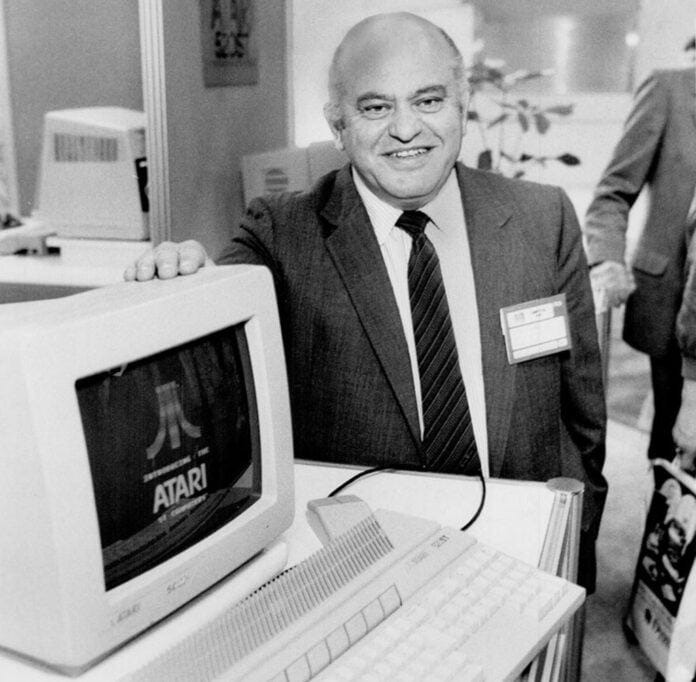
The founder: Commodore’s founder, Jack Tramiel, was a Holocaust survivor who believed in “computers for the masses, not the classes.” He built Commodore from a typewriter repair shop into a global brand focused on affordability and scale. After clashing with the board, he left in 1984 and bought Atari’s consumer division.
The fall: After Tramiel left, Commodore lost focus. The company released the Commodore 128, Plus/4, and Amiga, but they overlapped and confused customers. Apple built a reputation around design and creativity while IBM-compatible PCs became the business standard with Windows. Commodore stayed focused on a shrinking home market. By the early 1990s, it cost Commodore more to make a disk drive than the computer itself. The company declared bankruptcy in 1994.
When Steve Jobs returned to Apple in the 1990s, he rebuilt the company around design and integration. The iMac, iPod, and iPhone created a new consumer relationship with technology. Commodore never got that chance.
I think it would be cool if I get a beige computer next.
Tech News
Hardware
At OpenAI’s DevDay, Sam Altman and Jony Ive mentioned a “family of devices” in development but shared no details. I am very excited to see what’s in store. I feel like it could be something like an Alexa. (Wired)
Related: I didn’t think DevDay was that great, I was expecting more. Let me know what your thoughts are.
Tesla reportedly dropped plans to mass-produce thousands of Optimus robots in 2025 due to technical issues with their hands. A while ago, I remember talking to an engineer working on robots for farming who told me that creating something similar to a human hand to pick berries has been incredibly difficult because robots just smoosh them. Dexterity is hard. (TechSpot)
Video
OpenAI reversed course on Sora 2’s copyright policy after backlash over AI videos using protected content. The company now plans tighter creator controls and revenue sharing, a test for how AI video tools handle IP. (Copyrightlately)
MrBeast, expected to make $85M this year, warned that AI-generated videos could threaten creators’ incomes and called it “scary times.” Even top creators are uneasy about how fast AI is closing in. (TechCrunch)
Funding
PitchBook reports $192.7B has gone into AI startups this year, marking the first time more than half of venture funding went to one sector. (Bloomberg)
AltStore raised $6M led by Pace Capital to expand its alternative app store to Australia, Brazil, and Japan in 2025. I guess investors believe alternative app stores can compete with Apple. (TechCrunch)
SoftBank agreed to buy ABB’s robotics unit for $5.4B, acquiring a division with $2.3B in 2024 revenue and 7K employees. With the news that OpenAI is coming out with devices, I think the next wave of AI could be a bit more hardware focused. Normally very fun, but seldom a good idea if you want to make money. (CNBC)
More Money
JPMorgan says corporate debt tied to AI companies has reached $1.2T, about 14% of the investment-grade market and larger than US banks at 11.7%. (Tech in Asia)
Docusign’s stock fell 12% after OpenAI showed an internal “DocuGPT” demo built for document processing. (Wired)
Google launched an AI bug bounty program offering up to $30K for finding vulnerabilities in its AI systems. (The Verge)
Government
California passed the first US law banning excessively loud ads on streaming platforms like Netflix and Hulu. The rule could push national standards for how digital ads are mixed. (BBC)
Related: Did you guys hear about this Target ad?
 Tiktok failed to load.
Enable 3rd party cookies or use another browser
Tech firms in the UK, Canada, and other countries are courting talent as US H-1B visa limits tighten.(Financial Times)
Governmental bodies are to be using AI tools to write public facing pieces, like job boards. A study found about 24% of English corporate press releases and 14% of UN releases used AI writing tools by late 2024. (Gizmodo)

People
Michel Devoret, John Martinis, and John Clarke won the 2025 Nobel Prize in Physics for experiments proving quantum effects in superconducting circuits. Their work made quantum hardware real and set the stage for today’s race to scale the technology. (Reuters)
Riley Walz, a San Francisco coder known for tech-driven pranks like tracking parking police, was profiled for using code as commentary. (New York Times)